
Exploring Nature in the San Francisco Bay Area

What it takes to win land battles — a “badgerly” spirit

In west Petaluma, a hilly, treeless plot of land will be declared the Paula Lane Nature Preserve next month because of the tenacious work of local residents who were inspired by an equally tenacious creature — the American badger.

At the forefront of the effort is Susan Kirks, who co-founded the Paula Lane Action Network (PLAN) in 2001 in order to keep the 11-acre property out of the hands of housing developers. The 10 year land battle is coming to a close, but to Kirks there’s still work to be done. At 58, Kirks, an acupuncturist by day, has made a life’s mission out of studying, protecting, and providing PR for this much maligned member of the weasel family.

“I think there is a symbolic connection to make around the tenacity that she has shown, that badgerly spirit of digging in and not being deterred,” said Brock Dolman of the Occidental Arts and Ecology Center. “She could see the value of Paula Lane, and the badger became the totem species that represented a lot of that value.”

Dolman and Kirks often exchange badger sightings since she began the BadgerMap project, a research project on badger habitats in Sonoma County.

On a recent morning, Kirks walked gingerly around the badger habitat at Paula Lane,

land

Photo by Elizabeth Proctor. 

identifying foraging holes from dens that are nearly identical to the untrained eye, and with an ease in which most of us distinguish apples from oranges. She guessed the age of the dens to establish when the badgers were last there, then quietly retreated from the property, preferring to observe it from Paula Lane, the road running along its easternmost side.

“I’ve kept my boundaries,” she said. “The habitat is really important to understand. When I see fresh burrows, I want to stay as far away as possible.”

Just how Kirks fell in love with badgers, of all creatures, dates back to her arrival in the neighborhood 12 years ago. Having moved to west Petaluma with her two rescued horses, it wasn’t long before Kirks began to notice holes in the ground. A friend told her they were badger dens, which piqued her curiosity. She began to spend much of her time observing the land.

Kirks said her connection to the badgers at Paula Lane is healing and has reignited her childhood passion for the outdoors.

“The funny thing is, I never intended to become a naturalist that has a body of knowledge about the American badger,” Kirks said, laughing. “But the more I came to understand the species, the more I realized what a significant role it plays in ecosystems.”

Kirks feels a special connection to the Paula Lane badgers, who are naturally reclusive

Badger
A young badger is spotted near Paula Lane. Photo by Andy LaCasse, courtesy of PLAN. 
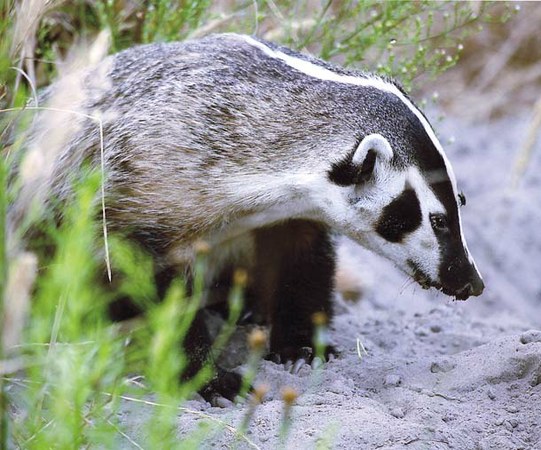
except when defending their young. Being a bit people-shy herself, she prefers to keep her cap pulled over her eyes. And she often jokes about her “badgerly” spirit, which she deployed in full force in the fight for Paula Lane.

Indeed, badgers may not be the most cuddly of creatures, but Kirks believes they have been unnecessarily maligned. Sport hunting of badgers for their pelts is still allowed in California from mid-November until the end of February, even though the population of these black-and-white striped omnivores has been declining because of habitat loss stemming from development.

As Kirks explains, badgers are a critical species to their grassland habitat. Their dens, which they inhabit temporarily before moving on, create useful habitat for California tiger salamanders, red-legged frogs, and burrowing owls. Badgers also hunt voles, mice, and gophers, keeping rodent populations in check. What’s more, studies have shown that badgers leave enough small prey for raptors like the red-tailed hawk, and even engage in cooperative hunting with coyotes.

Badger hole

Photo by Elizabeth Proctor. 

These qualities went into several reports compiled by local biologists to demonstrate their value in the face of the proposed development.

The development proposal was dropped in 2005, and PLAN orchestrated a partnership between the City of Petaluma and the Sonoma County Open Space District. Together, they agreed on purchasing the land as an open space preserve, under the condition that PLAN maintains the land.

In addition to preserving wildlife habitat, the Paula Lane Nature Preserve will feature a perimeter walking trail, a community garden, and a hands-on environmental education program, all maintained by PLAN volunteers.

Kirks is currently working on a research project that gathers information about badger habitats between south Sonoma County and the Sonoma Coast. The project, called BadgerMap, can be found online at iNaturalist, a website that compiles species sightings. Kirks hopes it will provide helpful data to researchers at the Bay Area Open Space Council for their upland habitat database.

Kirks said knowing the location of these habitats and the corridors that connect them will help protect wildlife as they migrate into new areas under climate change.

“She’s a force to be reckoned with,” said biologist Kim Fitts. “She pretty much single-handedly corralled people into doing their part, into making statements, and doing bake sales. It’s pretty amazing. Early on, I said I just don’t see it working.”

But it did work. And the badgers at Paula Lane Nature Preserve have their neighbors to thank for it.

Marin passes new tree cutting ordinance

The Marin County Board of Supervisors approved a new ordinance on Wednesday that further restricts tree-cutting, although salmon advocates say it doesn’t go far enough.  

Before the new ordinance passed, residents could cut down up to five trees of any kind, whether they were native or not, ancient or young, each year without a permit.  The Marin supervisors voted to restrict that number to two trees and protect “heritage trees” — very large, old, native trees — from being cut down without a permit. But the ordinance provides no restrictions for what are referred to as “protected” trees, which are mature trees that are not tall enough to pass as heritage.

Todd Steiner, Executive Director of SPAWN (the Salmon Protection and Watershed Network), said Marin could become virtually treeless over time if it doesn’t protect mature trees.

“It’s a failure of land use planning, it’s a failure to enforce resource management, and it’s a total failure of leadership by the county supervisors to do what’s right for the environment,” said Steiner.

He said the county needs to make sure that new trees replace those that are cut down, and it should close the loopholes that allow the cutting of any kind of tree.

Marin Supervisor Steve Kinsey acknowledged the importance of native trees to the health of riparian areas, but also said that in order to be effective, the development plan had to be both affordable and enforceable.  The county already faces budget challenges, he added.

“It would be unreasonably expensive and time consuming to seek a permit for every single tree in this county that needs to be brought down,” Kinsey said during the meeting. “We can always come back.”

The Board also approved exemptions to needing a permit for diseased trees and those that pose a health, safety, or fire protection concern.

Trees play a valuable role in soil regeneration, producing clean air and water, slowing the process of global warming, and providing moisture that potentially acts as a buffer during fires. But it’s their positive impact on salmon habitat that SPAWN is chiefly concerned with protecting.

Trees provide shade that keeps creeks cool, crucial to salmon survival.  They also act as buffers from sedimentation and chemical pollutants.  Roots that grow into the creek, as well as trees that die and fall into the creek, provide useful habitat for salmon.  Fog drip can also be important to maintaining stream flows. Steiner said trees are in a complex relationship with their habitats.

“When you have a stand of trees, you think cutting out the one in the middle to let in more sun isn’t going to make a difference,” said Steiner. “But those trees are all interacting with each other.  The tree on the outside is helping to protect the tree on the inside.  If you cut one down, you don’t know what the impact will be.”

Looking for that special Tat? Bay Area Millennials inked with endangered species


The name of the project is Tatzoo. The game is a good-natured competition among Bay Area Millennials concerned about local endangered species, and not afraid to show it — permanently.

The competition presents young people with a challenge: engage 100 people in the conservation of a local endangered species over the course of 100 days. Winners got something many Millennials covet — a brand new tattoo. The tattoos feature the endangered species, accompanied by its remaining population number enclosed in an infinity symbol.

“If someone is dedicated to a cause, then having something permanent to symbolize it, like a tattoo, is really powerful,” said Amanda Go, an artist at Sacred Rose Tattoo in Berkeley who donated her work to the project.  “It’s like a statement saying, ‘I’m serious about this.’”

Tatzoo, funded by TogetherGreen’s innovation grants program, seeks to engage Millennials — 18 to 35 year olds — in a fight for biodiversity during the sixth greatest extinction crisis to occur in the last 25 million years.  The young people of this generation, whose childhood toys, games, and movies so prominently featured animal characters, will see the extinction of many of these creatures due to human folly, unless something is done.

With two hundred species disappearing every day, this was no light task.  But young conservationist Molly Tsongas, founder of Tatzoo, wasn’t ready to give up — on endangered species, or the Millennial generation.

Tsongas, 30, founded the competition because she felt there were not many exciting opportunities for young people to personally engage in the biodiversity movement.

“The people of our generation are the ones who are going to be experiencing this crisis, and it’s only fair to give them a chance to respond,” she said.

And thus Tatzoo was born: endangered species, crowd-sourcing, and tattoos, all rolled into one competition.  Participants were provided Flip cameras and required to submit weekly video updates.  No other guidelines were given.  Because of the open-ended nature of the challenge, Tsongas reports that she was surprised by the creative and interesting methods of crowd-sourcing.

 Methods ranged from brewing a microbeer called Spotted Owl Brew, to engaging local bakeries to put labels featuring endangered species on products, to hosting a huge cuddlemob in Dolores Park to mimic the cuddling habits of the Stellar Sea Lion.

“It’s a really special feeling to know I’m so connected to this endangered species,” said Ashlee Jenson upon completion of her tattoo, a Northern spotted owl.  “I will be a voice for them for the rest of my life.”

It turns out that tattoos and endangered species quite naturally go hand-in-hand. Artist Amanda Go said that animals and plants are the most popular subjects for her tattoos.  “Animals and nature never go out of style,” she said.  “They’re really timeless.”

Tattoos seem appropriate in a project that seeks to inspire the Millennial generation.  In an age when tattoos are a relatively common and acceptable form of self expression, they may very well be another aspect that permanently marks this generation.

Tatzoo’s competition will repeat in 2012.

Tunnels for Tiger Salamanders

This winter, the traffic bottlenecks around Santa Rosa might be a little easier to manage–at least if you happen to be a California tiger salamander.

Santa Rosa’s population of tiger salamanders, declared endangered in 2000, will be able for the first time to get to breeding ponds through several special tunnels installed underneath busy roads.

David Cook, a biologist from the Sonoma County Water Agency, says the tunnels could reduce roadkill and make a difference for the dwindling population. “These salamanders are migrating to a pond to breed, and if they get run over before they breed, then that’s a big hit for the population,” says Cook. “The important thing to consider about tiger salamanders is that they occur in lowland areas in Central California, which have a really high pressure for development, so the salamanders are always having these kinds of urban conflict issues. If these tunnels can be effective, then it’s one more resource to reduce the impacts from urbanization.”

The California tiger salamander once occurred throughout the Santa Rosa Plain, when there was still a vast oak savannah with a complex connecting system of vernal pools, creeks, and seasonal wetlands. Now, however, urban development has eliminated most of the salamander’s habitat. Its life cycle is called biphasic – it requires two distinct habitats, wetlands and uplands. If one is eliminated, the salamander will go extinct. While the wetlands provide breeding grounds for the salamander and a home for young from larval stages through metamorphosis, the uplands provide access to burrows dug by gophers and other small mammals, where the adult salamanders find shelter during the warm summer months.

In August of this year, the U.S. Fish and Wildlife Service designated 47,383 acres on the Santa Rosa Plain as a protected critical habitat for the California tiger salamander. But, as development is still being proposed for the area, it is unclear how much the critical habitat designation will help the salamander.

So what is the most important thing that can be done for the salamander?

“Ultimately, we have to stop destroying their habitat,” says Brock Dolman, an activist and Water Institute Director at the Occidental Arts and Ecology Center. “We need to maintain the largest contiguous patches of connected habitat. We can’t lose any ground on the existing habitat because it’s already way too fragmented.”

Many Sonoma County residents are probably unaware of the existence of this sensitive creature in their midst, but the California tiger salamanders represent an ecosystem that itself is on the verge of dying out.

“I personally think that people should be concerned about the salamander because they are an indicator of the integrity of a certain ecosystem that has both an upland terrestrial valley oak savannah and an aquatic system of vernal pools,” says Dolman, who has worked to spread awareness of the salamander and its plight. “That entire complex is unique, and, I think, a critical ecological system to be preserved in its own right.”

Dolman and Cook appeared in a funny and informative 2009 mock news video from the fictional KCTS station (that’s K-CA-Tiger-Salamander!).

Sea Level Rise Could Wipe Out Ocean Beach

A study released last week found that rising sea levels along the West Coast could take a significant economic toll on five California beaches over the next 100 years. One of those beaches is San Francisco’s very own Ocean Beach.

Ocean Beach is a prime Bay Area surfing spot, a popular site for bonfire parties, a common tourist destination, and a vast recreation area for runners, beachcombers, dogs, and dog owners. The beach is also a habitat for wildlife, including various plovers, other birds, and native vegetation. Additionally, beaches offer a lot of economic value that supports surrounding shops, restaurants, and bars with a steady influx of visitors.

However, the new study, funded by the California Department of Boating and Waterways, offers some distressing and eye-opening findings.

At Ocean Beach, flooding and episodic storm events, whose likelihood increases with rising sea level, could result in an estimated $20 million in damages to nearby structures and their contents by the year 2100. And accelerated landward erosion from an estimated 1.4-meter rise in sea-level by 2100 could result in $540 million in damages.

“If you continue to let Ocean Beach erode,” says study coauthor Philip King, an economics professor at San Francisco State University, “you’re going to lose the Great Highway and you’re eventually going to lose residential properties.”

The options for Ocean Beach are limited, but they do exist. King mentions a few of the issues currently under discussion: “For instance, putting a sea wall there, which most people don’t want, adding sand to the beach in places, having managed retreat which lets nature take its course, and there is the issue of what to do about the habitat and possibly restoring native plants.”

Although erosion is ultimately of greater economic concern at Ocean Beach than flooding, addressing the issue involves weighing the benefits against the costs, and not just economic ones.

Armoring the shoreline with seawalls could prevent landward erosion, but doing so means that the ocean will eventually meet the seawalls, and the beach will have disappeared, along with valuable wildlife habitat. Currently, snowy plovers, whose Pacific Coast population is designated as a threatened species, uses the beach for winter roosting. And the southern end of Ocean Beach, at Fort Funston, is home to one of only two colonies of bank swallows remaining in California. Other animals that make use of the habitat at Ocean Beach include killdeer, black-bellied plovers, and sanderlings.

King states that the most important thing that can be done for Ocean Beach is to carry out thoughtful steps to minimize our losses. “Look at the issues and decide as a community what our priorities are. How important is it to preserve habitat in Ocean Beach, to preserve recreation, infrastructure, highways, residences, water treatment plants? Ultimately there are trade-offs and we’re going to have to spend money. One way or another it’s going to cost San Francisco money down the road.”

Download the full study, coauthored by King and colleagues Aaron McGregor and Justin Whittet.

New Photo Exhibit Reveals Diversity in a Cubic Foot of SF Bay

The Golden Gate Bridge, approaching its 75th anniversary in May 2012, is the most photographed bridge in the world — but what about what lies underneath it?

Photographer David Liittschwager decided to address just that. As part of his “One Cubic Foot” series, Liittschwager photographed the abundance of life that travels not over the bridge but below it, inside a one cubic foot sample of water in San Francisco Bay. His photos will be featured in an exhibit opening at the David Brower Center in Berkeley this week, with a reception on Thursday, September 15.

Perched on a simple sailboat, he and a team of scientists settled on the north anchorage of the San Francisco Bay just inside Kirby Cove and photographed a series of samples to approximate the activity that occurs over the course of a normal 24 hour span.

Photo from One Cubic Foot Project
Photo © David Liittschwager

In only two minutes, an estimated 550,000 creatures passed through a cubic foot of this complex and diverse waterway. Liittschwager estimates that approximately 2.6 billion creatures pass through a cubic foot of space in the Bay over the course of 24 hours — more than the number of cars that have passed over the Golden Gate Bridge in its entire history.

Because the water under the bridge is a combination of estuary and open ocean, the 100 species in the photos are characteristic of both environments.

Given the limitation of a cubic foot, we’re not talking about sea lions or porpoises here. The organisms in the exhibit, all enlarged to make their intricate details visible, include communities of algae a few inches across and worm larva less than a millimeter long.

“That’s the frontier here,” says Liittschwager about the microscopic organisms blown up to the size of our finger pads in his images, “to show that these are really not just blobs. They can’t swim against the current, but they can control their buoyancy. They can navigate by moving vertically in the water column, and that’s how they can have some sense of independence, of controlling their destiny in one way or another.”

Seeing, probably for the first time, so many living things that exist in a local environment invites the viewer to consider the rich complexity of the bay, and, subsequently, the entire natural world. “I find that it enriches one’s experience to know that the world is that much more fantastic than you’d ever imagined,” Liittschwager says. “The original idea of the ‘One Cubic Foot’ project came from two things. One was something that [biologist] Edward O. Wilson wrote about how the entire lives of barely visible organisms play out in small spaces that human beings are likely to dismiss. And then there’s something in the final paragraph of Darwin’s ‘On the Origin of Species’ about how the world makes itself every day in small interactions, and they happen in specific places, so it’s interesting to watch that, the little glimpse of it that we actually get to have.”

Liittschwager has previously photographed a cubic foot of space in a cloud forest in Costa Rica, in leaf litter in New York’s Central Park, in fire-prone shrubland in South Africa, and in a coral reef in French Polynesia.

So what makes San Francisco Bay special?

“San Francisco Bay is one of the most radically altered habitats in the world,” Liittschwager explains. “It’s been seriously changed by people, for instance with the Gold Rush, and even before that with introduced species that were brought on the hulls of ships from other places in the world. So San Francisco Bay is hugely altered – damaged, forever changed, or whatever words you want to use, but it is radical for sure, and in some ways, an environmental disaster. But it’s also very much still alive and in many ways it’s recovering, as is demonstrated by things like the return of the harbor porpoises. There are all sorts of reasons to treat the bay better.”

Amy Tobin, executive director of the David Brower Center, which commissioned the work, hopes that the exhibit will spark a dialogue about the state of the bay, the species that thrive in it, and how it is threatened. Tobin, who sailed out with Liittschwager to photograph images, says of the project, “It changes your relationship with a space.”

The “One Cubic Foot” exhibit will be open and free to the public from September 15, 2011, through January 27, 2012, in the Hazel Wolf Gallery at the David Brower Center, 2150 Allston Way, Berkeley. The opening reception is from 6 p.m. to 9 p.m. on September 15 and will include a slideshow at 8 p.m. Learn more>