In the Fault Zone
April 01, 2006 by Horst Rademacher
On April 18, 1906, a massive earthquake centered just west of San Francisco ruptured the earth from Humboldt to San …
April 01, 2006 by Horst Rademacher
On April 18, 1906, a massive earthquake centered just west of San Francisco ruptured the earth from Humboldt to San …
April 01, 2006 by Aleta George
Thriving in cold, dark waters 4,265 feet below sea level, communities of large, ancient, and colorful corals grace the peaks …
April 01, 2006 by Aleta George
The North Bay is having a bit of an environmental building boom. PRBO Conservation Science, the noted research organization based …
April 01, 2006 by Aleta George
After flying flags at half-mast for 22 days throughout the East Bay Regional Park District (EBRPD), the district’s board members …
April 01, 2006 by Aleta George
The Bay Area has a rich history of women speaking out to protect lands we know and love. At the …
April 01, 2006 by Aleta George
In late December 2005, the National Marine Fisheries Service (NMFS) reaffirmed the threatened status of Central California Coast steelhead trout …
April 01, 2006 by Wanda Sabir
On San Francisco’s southeastern waterfront, Heron’s Head Park hosts nesting avocets, nature education programs, and the seeds of a revitalized city Bay shore.
April 01, 2006 by Cindy Spring
The single-track trail along the creek looks quite inviting: just wide enough for hiking, with no fallen limbs or nasty …
April 01, 2006 by Sue Rosenthal
Plate Tectonics And Earthquakes
National Earthquake Information Center
USGS website providing current data on earthquakes worldwide.
http://earthquake.usgs.gov/regional/neic/
USGS Earthquake Hazards …
April 01, 2006 by Horst Rademacher
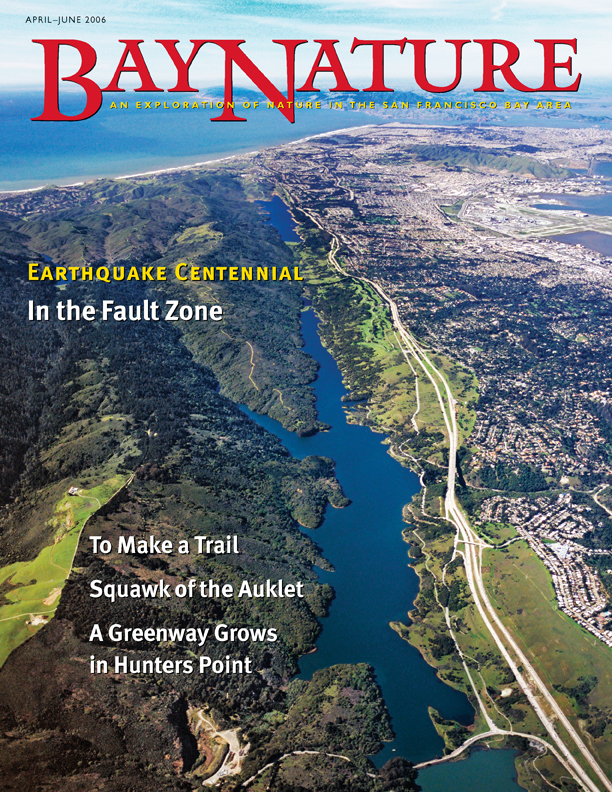
On April 18, 1906, a massive earthquake centered just west of San Francisco ruptured the earth from Humboldt to San Juan Bautista. While the more dramatic traces of this 7.8 temblor may be hard to find one hundred years later, the tectonic forces that moved the earth that day are still relentlessly shaping our young and active landscape, carrying us towards another cataclysm in the near future.
April 01, 2006 by Doris Sloan
All of the familiar landforms we see here in the Bay Area—ridges, cliffs, lakes, and even San Francisco Bay itself—are products of the same titanic encounters between tectonic plates that produce our frequent quakes. Through a geologist’s trained eye, we learn to interpret the signs these forces have left on the land around us.
April 01, 2006 by David Loeb
I was working at my computer at the Bay Nature office in Berkeley the other day when I was interrupted …
April 01, 2006 by Bill O’Brien
Trails are the main way we access most of the Bay Area’s diverse and abundant open space. Despite that, it’s easy to forget that trails have to be planned and built by someone. However, for the East Bay Regional Park District, which has over 1,000 miles of trails, this is a full-time job. At places like the newly-opened Brushy Peak Regional Preserve, trail planners must balance people’s desire for access with the needs of native plants and animals.
April 01, 2006 by Aleta George
Vernal pools are havens for specialized species, including the endangered Contra Costa goldfield and the native solitary bee that pollinates it.
April 01, 2006 by Michelle Hester
Not many people get to visit Año Nuevo Island—you need a rubber boat, a strong stomach, and a research permit. But sea lions haul out here in droves, and hundreds of seabirds—including rhinoceros auklets—come to breed on its few wind-swept acres. Today, erosion is threatening the auklets’ deep burrows, so researchers are working to restore this critical breeding site for these strange-looking seabirds.